
VW Sensor Calibration Factor Testing - Google Sheet
Select the button above to go directly to the online Google Sheet created to test the calibration factors for a vibrating wire sensor.
The User is free to make a copy of the Keynes Vibrating Wire Sensor Calibration Test Sheet.
Should there be any access problems then contact sales@keynes-controls.com for assistance.
Keynes Controls offer two free tools to help test out and configure vibrating wire sensors and configure hardware. A Google sheet is available online that can be used to test the sensor calibration factors for both temperature and frequency sensor components.
The Free Windows QLOG software that is supplied with all of our sensor interfaces can be used to write the sensor configuration into the devices.
Use the Google sheet to test out the sensor configurations, then cut and paste the values into QLOG for writing into the vibrating wire sensor interfaces.
The Google Sheet results can be cut and pasted into the VibWire-201 software for storage into the handheld analyser,
The Google sheet will give the same results as that of an instrument but without the use of any hardware.
SI Units - Pressure, strain, Load etc..
The sheet can be configured to use frequency in Hz and Digits.
.
Select screens to enlarge.
|
Vibrating Wire Sensor Configuration Test Program
|
|
Based on equation
SI Units = C(F²) + BF + A - D(T₀-T) + (S₀-S) |
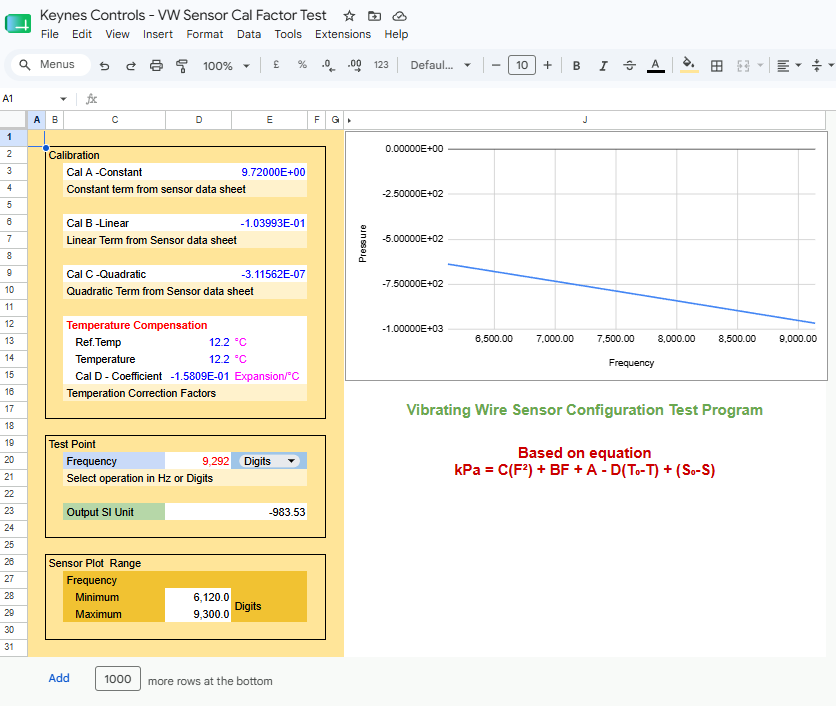
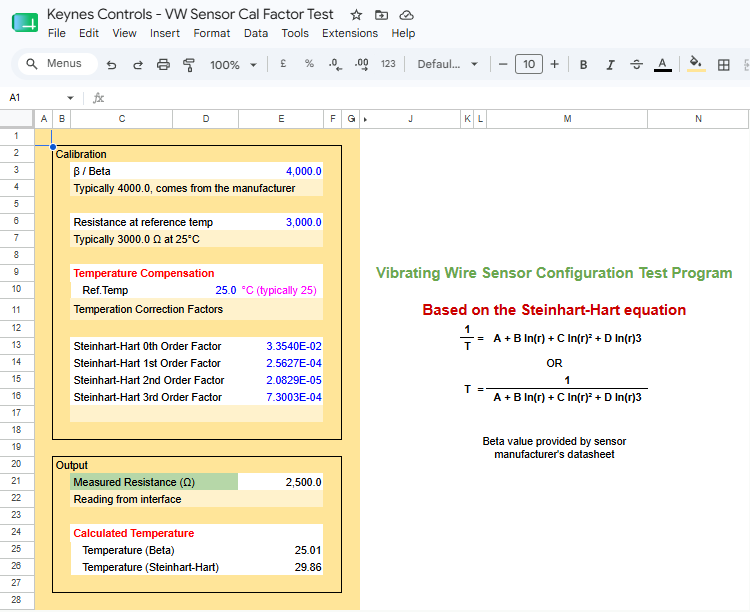
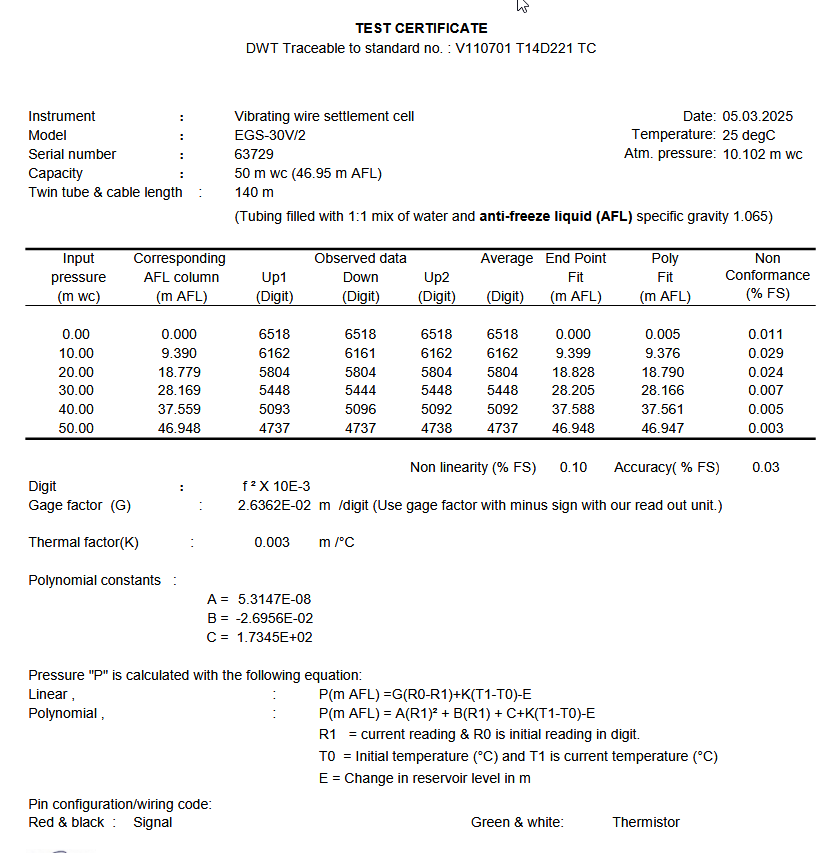
Example Sensor calibration Parameter Settings
One of the hardest thing to do when configuring vibrating wire sensor hardware is to assign the sensor manufactures calibration factors correctly.
Once setup up correctly the sensor interface will measure a frequency signal and give an output in the correct SI Units. When using a sensor interface that supports SDI12, RS485 and MODBUS communications then the measurements can be set to report in engineering units.
When using the analogue, or current loop output then the output signal is proportional to the frequency or temperature signals. The user will have to undertake the conversion of the signals into there corresponding SI Units.
The example is using the VW sensor quadratic factors
A = Offset Term
B = Linear Term
C = Quadratic Term
D = Thermal expansion
From the example calibration sheet
A = 1.7345E+2 B = -2.6956E-2 C = 5.3147E-6
Thermal Expansion D = 0.003
The equations can eb different between sensor manufactures so take care when assigning the terms.
Selecting the Calibration Factors
All of the Keynes Controls vibrating wire sensor interfaces use the same configuration settings. The output from the interfaces can be in Hz, Digits, or SI Units. For the multichannel devices then any mixture of output type can be accommodated.
The sensor configuration for any Vibrating Wire interface by Keynes Controls will be set to supply vibrating wire sensor readings directly is SI Units. The SI units shown in the example are in units m wc. Care has to be taken to ensure the correct order for the factors A, B and C are identified and used.
Different sensor manufacturers assign different meaning for the calibration factors.
The Window opposite is from the Keynes Controls QLOG Software Configuration settings for channels 0 and 1 in the VibWire-108 instrument. The VibWire-108 supports 8 x 4 Wire sensor inputs.
Setting Channel 0 into SI units
Chan 0 Frequency Output = 2 0 = Hz 1 = Digits 2 = SI Units
Temperature Sensor Settings
Chan 0 Therm no = 1 The industry standard Steinhart-Hart calibration factors are pre-set.
Vibrating Wire Calibration Factors
The calibration factors used in this example are taken from the sensor calibration sheet shown above. Select the image to zoom in.
Based on equation
Output SI Units = C(F²) + BF + A - D(T₀-T) + (S₀-S) - quadratic equation
The factors (S₀-S) - initial sensor conditions - offset only and is frequently ignored as they only effect the offset.
Instrument QLOG Configuration
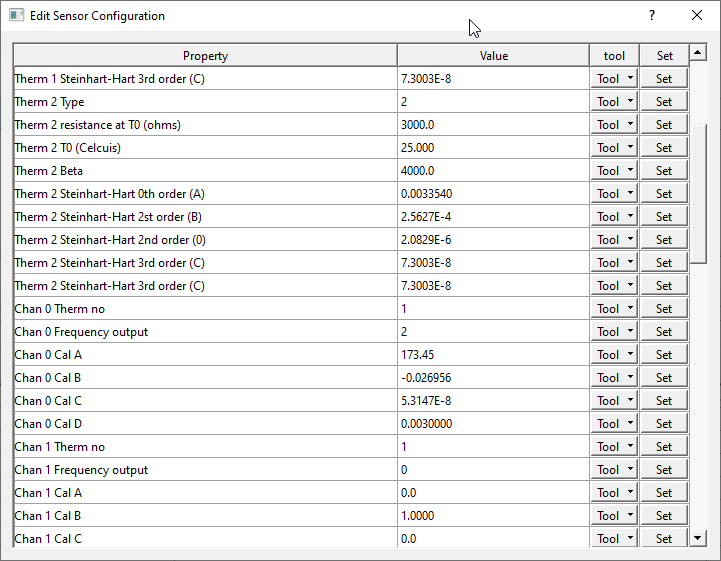
The vibrating wire sensor calibration parameters can be cut and pasted into the Sensor Configuration in the QLOG software.
Vibrating Wire Stress meter Calibration Factors
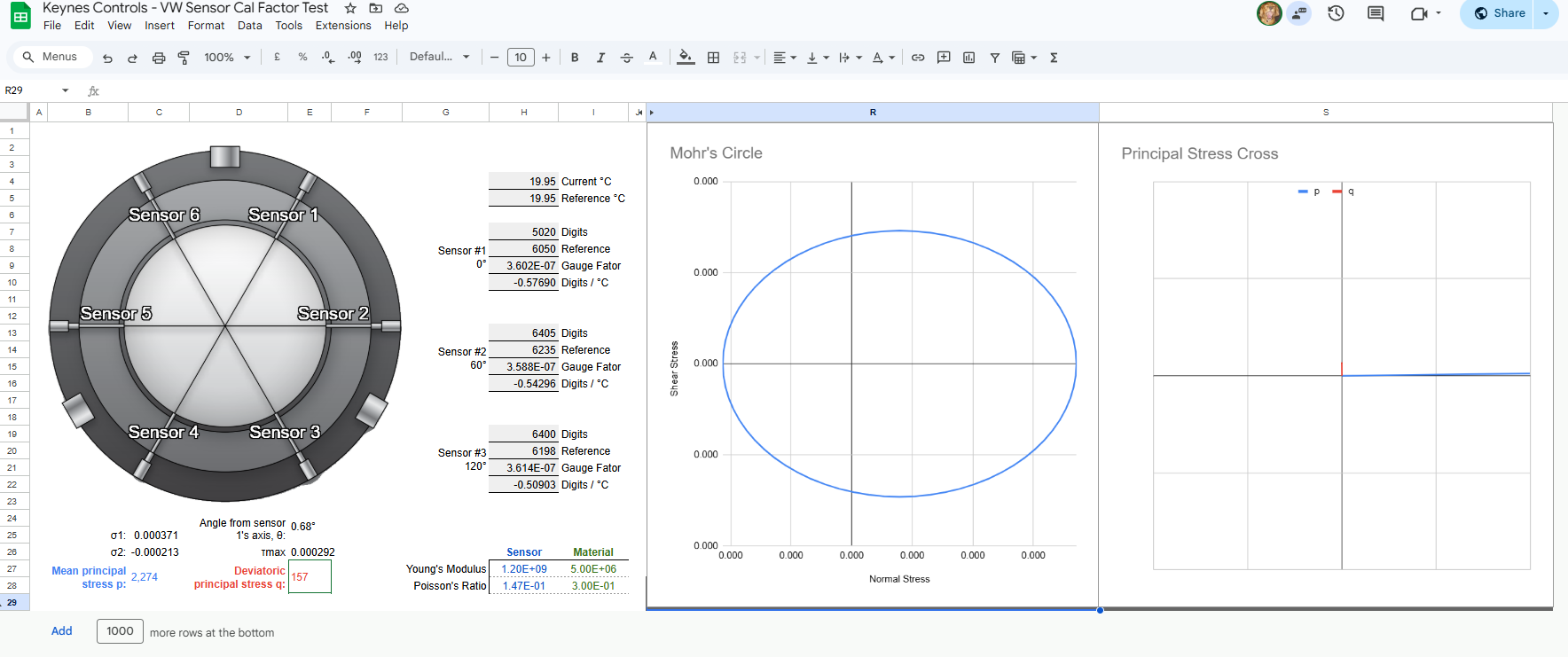
The Vibrating Wire Google supports the calibration factor testing of a 3 and 6 sensor bi-axial vibrating wire stress meters.
The stress meter has between 3 and 6 separate vibrating sensors built into a single device. Only 3 sensors are required for the calculations. The second set of sensors are for redundancy in the sensor operations.
The Mohr circle will show the expected deformation in the cylinder under the applied stresses.
The sheet will show the principal stress and the Angle from sensor 1's axis, θ.
Results obtained from Google Sheet
Deviatoric principal stress q:
Mean principal stress p:
Angle from sensor 1's axis, θ:
The Mohr circle will show a representative deformation of the sensor cylinder.
Principle Stress Cross : angle θ:
Required Parameters for Stress Meter Calibration Setup
The google sheet requires the following parameters for the stress meter in order to correctly calculate results. The parameters should be available on the manufactures calibration sheet.
Gauges Factors: Sensors 1,2 and 3
Digits / ℃ - Temperature Compensation Sensors 1,2 and 3
Material (Rock): Youngs Modulus Poisson's Ratio
Sensor : Youngs Modulus Poisson's Ratio
Current Temperature ℃
Reference Temperature ℃
Initial Sensors Readings: Digits for Sensors 1,2 and 3
Sample Test Parameters - 3 sensor Bi-axial Stress meter
Rock Sample: Youngs Modulus 5E+6 PSI Poisson's Ratio 0.3
Initial Sensor Readings (No Stress)
Axis (Sensor 1) : 6050 Digits Axis (Sensor 2): 6235 Digits Axis (Sensor 3): 6198 Digits
After the application of stress the sensor readings are
Axis (Sensor 1) : 5020 Digits Axis (Sensor 2): 6405 Digits Axis (Sensor 3): 6400 Digits
The sensor Gauge Factors are:
Gauge factor (Sensor 1) 3.602E-7 GF (Sensor 2) 3.588E-7 GF (Sensor 3) 3.614E-7
ARGES Turbidity, Tryptophan, ARGES Ammonia, ARGES Ammonium, ARGES Hydrocarbon, PAH, Poly Aromatic Hydrocarbon, Dissolved Oxygen, ARGES pH, ARGES Potassium, rivers, streams, ditches, cuts, culverts, dykes, sluices, sewers, multiparameter, SONDE