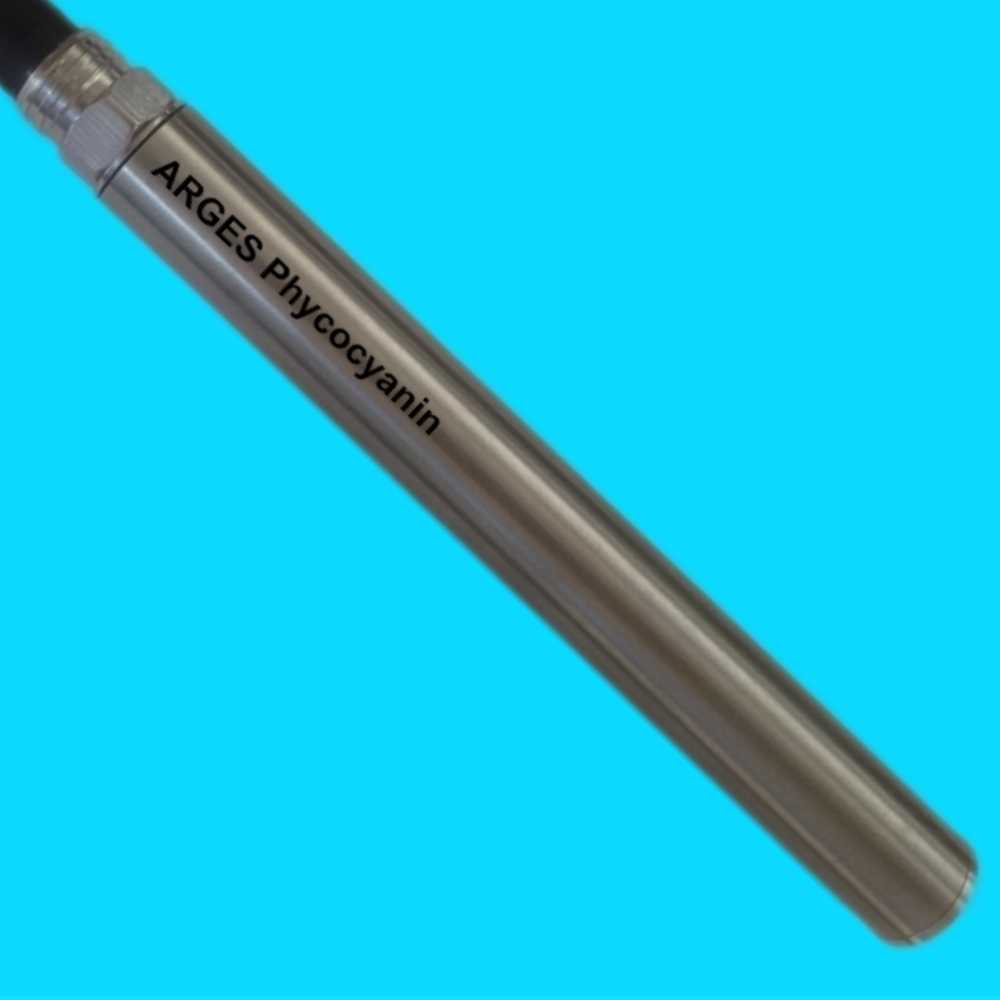
Many instruments available for measuring fluorescence of Phycocyanin are old-fashioned, complex to use, expensive, and require a high degree of proficiency to operate. These instruments may also require expensive additional housings and accessories before they can be deployed for any monitoring task. End users who are looking for a simple to use instrument to make fluorescence measurements of Phycocyanin need look no further that the ARGES Phycocyanin sensor.
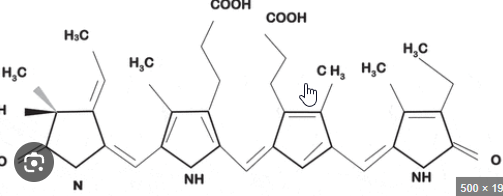
Phycocyanin (PC) is a green-blue pigment found especially in cyanobacteria, commonly identified as blue-green algae and is a highly specific indicator for the prescence of these particular algae in water.
The ARGES Phycocyanin ™ sensor is a single-channel instrument that can detect and report Phycocyanin levels in the range of 0.5 - 1000 ppb. The sensor has been designed to be used as a stand-alone laboratory instrument, as part of a multi-parameter device inside a Keynes Controls SONDE.
Why Measuring Phycocyanin is IMPORTANT
The measurement of phycocyanin levels in water sources such as rivers, lakes, estuaries etc.. is critical due to the risks associated with cyanobacteria
Public Health Risk
The monitoring of phycocyanin helps to detect the early formation of cyanotoxins that are known to create a range of health issues such as skin irritation, liver damage, gastrointestinal problems. Use the sensor to help protect public health in recreation water sources.
Harmful Algal Blooms (HAB) Indicator
High levels of phycocyanin are used as an indicator to cyanobacterial bloom. Many types of cyanobacteria can produce toxins that are harmful to humans and animals.
Ecosystem Impact
Cyanobacterial blooms reduce water clarity, deplete dissolved oxygen levels (DO) as they decay.
When to deploy the sensor
Compliance Monitoring
Use the ARGES Phycocyanin sensor to make sure the water supplier is adhering to water quality guidelines regarding cyanobacterial levels, especially of interest in areas where treated water is charged into rivers.
Drinking Water Sources
Use the ARGES Phycocyanin sensor to monitor for the early detection of the algae blooms entering the water supply especially if the water supply if from surface waters.
Environmental Protection
Use the ARGES Phycocyanin to assess the health of local ecosystems and identify areas effected by nutrient pollution from fertilisers or sewage.
Q-LOG Product Application Software
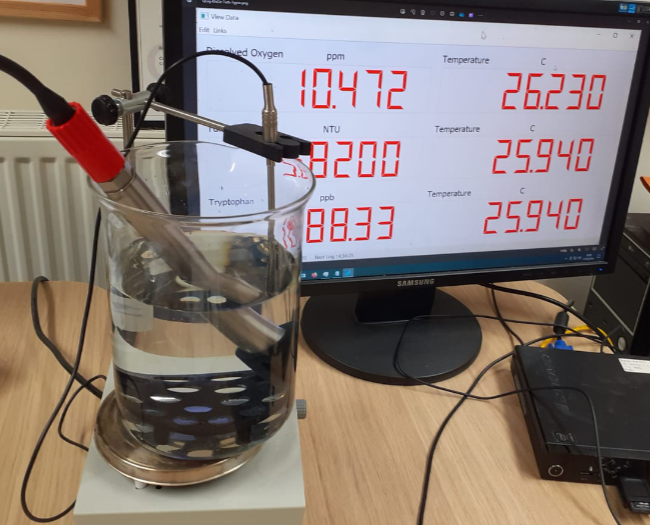
The ARGES Phycocyanin sensor is supplied with a free copy of the Keynes Q-LOG Applications software that can be used to Calibrate, make configuration changes, test measurements, display real-time results and store measurements into a CSV text file for simple analysis in a spreadsheet.
The Q-LOG Software can display single and multiple sensors across a network. This can be individual instruments or multiple SONDES. The results can be shown on a panel meter, charts or into a spreadsheet.
The image opposite shows a single sensor in test calibration solution.
Calibration Period
All of the sensors are Factory-calibrated before shipment. The advanced design of the sensors means that the time between re-calibration of an instrument is minimised. Keynes Controls recommends a check calibration every 2 years. The User can adjust the calibration for a specified range to improve accuracy for dedicated tasks.
Calibration Solution
25ml Bottle of 20% WT Rhodamine Dye Stock Solution. (Dilutions of this dye can be used to calibrate Chlorophyll, and both blue-green algae sensors). Dilution process is explain in the main page and probe manual.
Optional Accessories
Keynes Controls manufactures a range of accessories that can be used to connect the ARGES range of sensors to a Windows computer system and enable the sensors to be used in Laboratory applications, multi-parameter instruments and calibration operations.
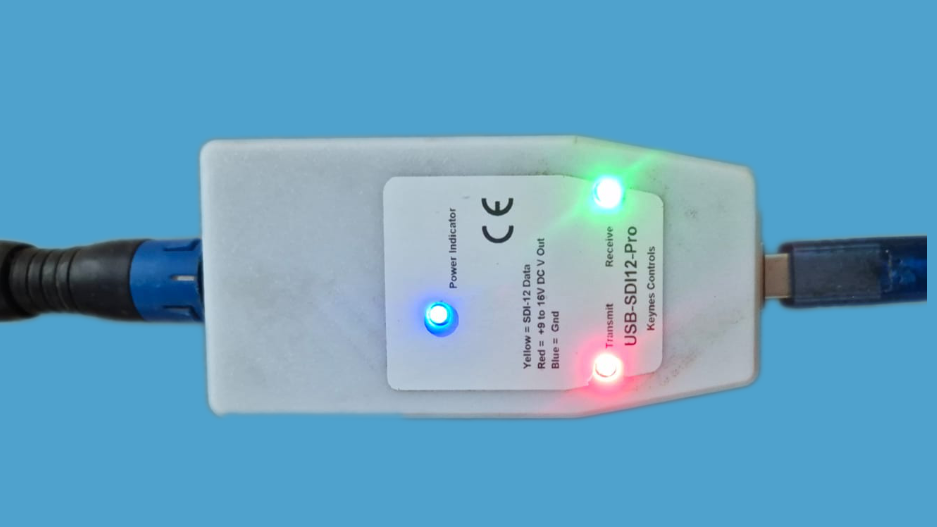
The optional USB media converters can be used to connect a multi-parameter instrument to a PC.
A virtual communications port feature is available enabling the software to talk to the instruments across a Local Area Network or Multi-parameter Housing.
Product Features
| TYPE | RANGE (Typical levels) |
| Solid state Fluorometer | |
| Concentration range: | 0 - 200,00 cells/mL |
| Resolution: | 1 cell/mL |
| Accuracy: | +/- 10% of reading. |
| Operation: | Stand-alone / SONDE Multiparameter operations |
| Warranty: | 2 year, depending on usage. |
| Depth Rating | 50 m standard - Other ranges on request. |
| Optional USB Interface | Part No. USB-SDI12-AG1 |
| Absorbtion | 620 nm |
| Digital Communications | SDI12 / RS485 / MODBUS Digital Communications |
| Calibration: | 2 point using rhodamine dye. |
| User Defined Range | User defined upper and lower limits |
| SI Units |
µg/L , RFU, cells/mL, Deg Celsius |
Multiparameter SONDE Housing
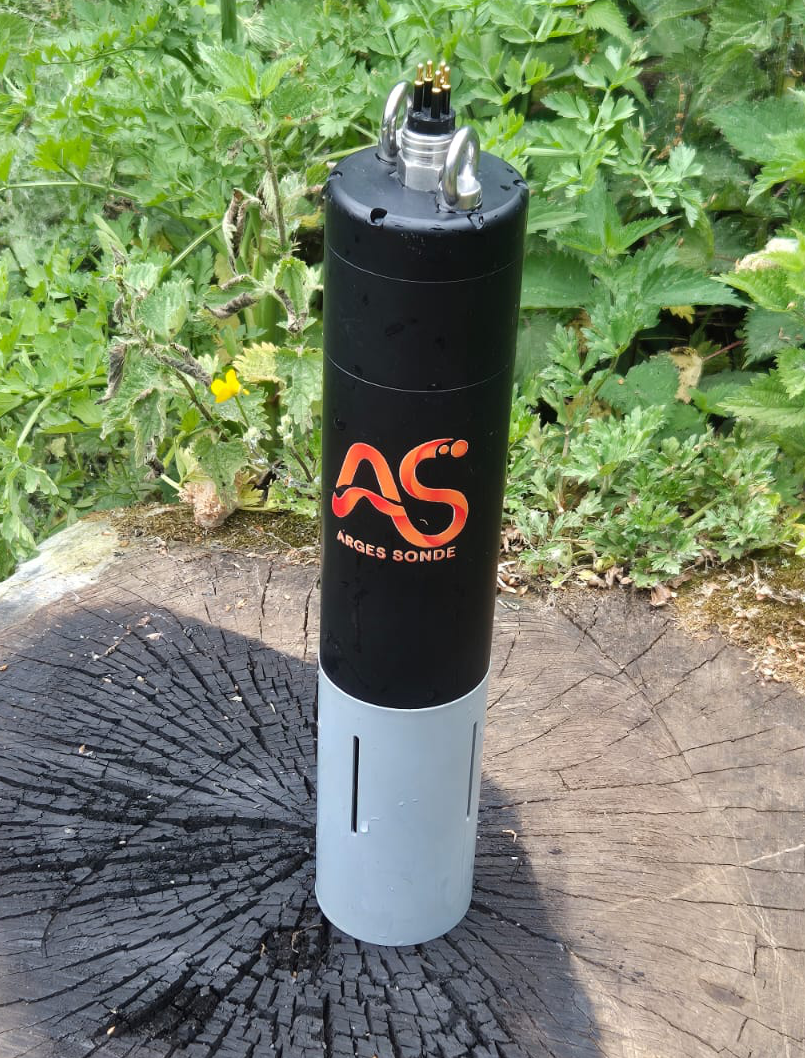
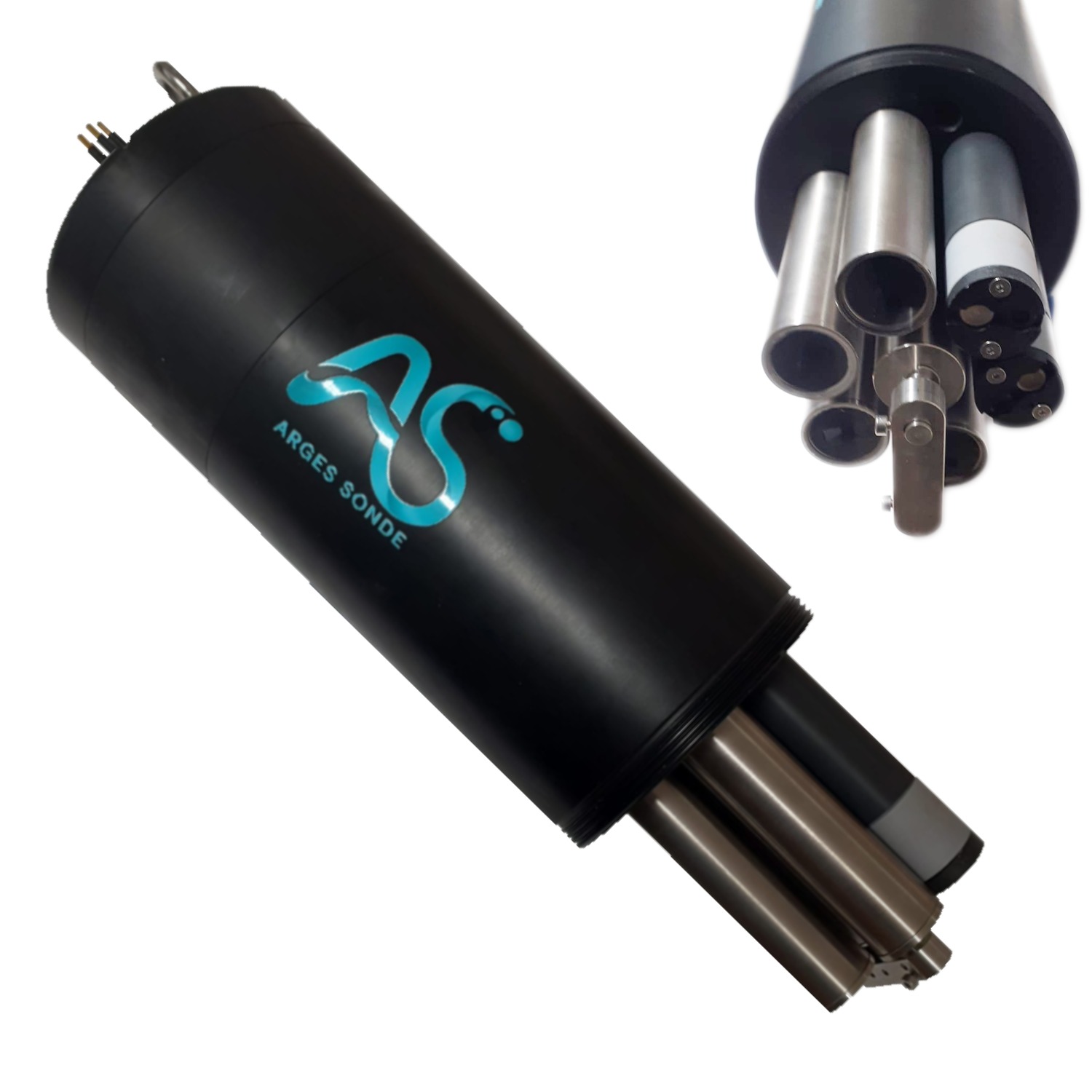
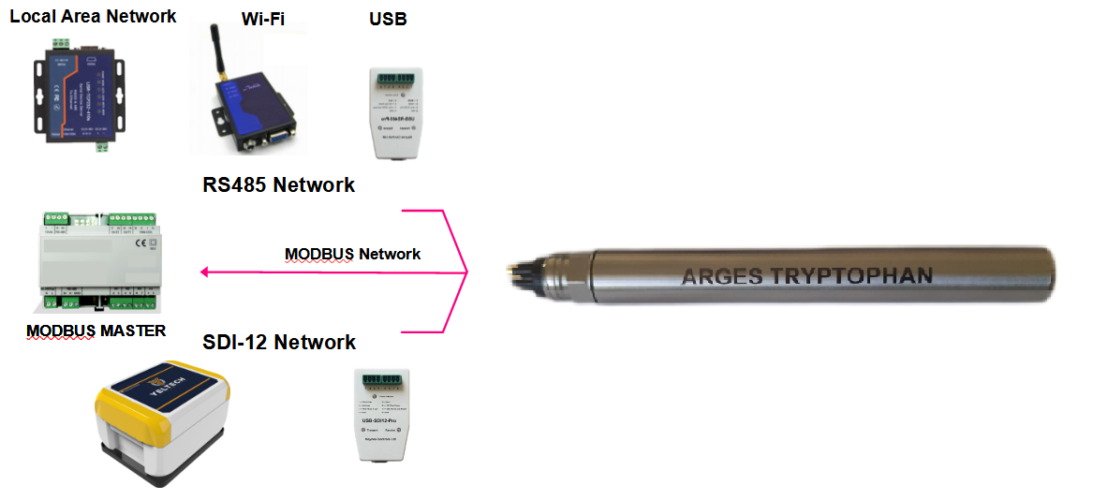
The ARGES Tryptophan Sensor by Keynes Control can be used as a stand-alone laboratory instrument, as part of a multi-parameter solution when installed into the Keynes 3-Sensor or 7-sensor SONDE housings. All types of sensor deployment can connect to a MODBUS, Local Area, Wi-Fi, SDI12, and RS485 networks when used with a suitable media converter.
Keynes Controls offers optional USB media converters that can connect the instrument to a PC and also directly power the sensor from the PC USB port.
Shade Cap
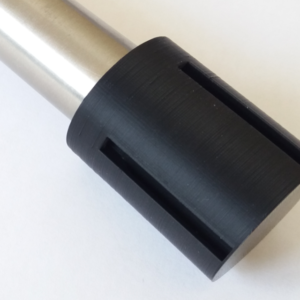
A shade cap shown below, containing a baffle is pushed onto the end of the sensor. The shade cap prevents damage to the sensor optics and also prevents background illumination for the fluorometers that can affect results. A baffle is used to ensure that the water flow is restricted to ensure accurate measurements can be made.
The shade cap is only required when deploying the sensor without a SONDE multi-parameter housing, or for sensor operations in the lab. Replacement caps can be ordered from the on-line shop.
Specifications
| ENVIRONMENTAL CHARACTERISTICS | ||||
| Phycocyanin | MDL 0.02 RFU | Range 0 - 100 ug/L | Non freeze | |
| 0 - 200,000 Ceels/mL | Ambient Range: 0 - 50 Degree Celsius | |||
| Water Temperature: -5 to 50 Degree Celsius | ||||
| Accuracy | +/-10 % of Reading | |||
| PHYSICAL DIMENSIONS | ||||
| Resolution | 0.01 RFU | |||
| Length x Diameter: 22 x 220 mm | ||||
| Pulse Width |
|
Weight: 97 g | ||
| Wiper Trigger | SDI12 Command | aM! | Maximum Depth : 50 m - Other ranges on request | |
| Excitation | 620 nm - Fluorescence 657 nm | Built-in Network Types: | ||
| Housing | 316 Stainless Steel | MODBUS / SDI12 V1.4 / RS485 | ||
| Focal Point | In-front of sensor faceplate | Analogue Ouput : 0- 2 V DC (Optional) | ||
| Data Output | SI Units - µg/L , RFU, cells/mL, Deg Celsius |
Supply Voltage: 10 - 15 V DC Standby Current 5 mA Standby/ 80 mA active 1 second |
Supported Commands
| Most commonly used commands | ||
| Description | Master | Sensor Response |
| Send ID | aI! | a13KEYNESVWRDOA001\r\n |
| Address Query | ?! | a\r\n where a = Address |
| Start Measurement | aM! where a = Address | a0261\r\n |
| Concurrent Measurement: | aC! where a = Address | a0261\r\n |
| Get Measurement | aD! where a = Address | a+Lead-µg/L+Temp (Degree Celsius) |
Built-in Communication Options
The ARGES Tryptophan Sensor by Keynes Control supports SDI-12, RS485 and MODBUS digital communications as standard enabling the sensors to be directly connected to Data Logger for remote web based reporting, onto Wi-Fi and Local Area Networks using the RS485 option, and directly into SCADA applications using the MODBUS.